 The Midlife Wellbeing ClubJoin The Midlife Wellbeing Club
← All posts · 11 November 2026
What can I do if I can’t take HRT — or don’t want to?
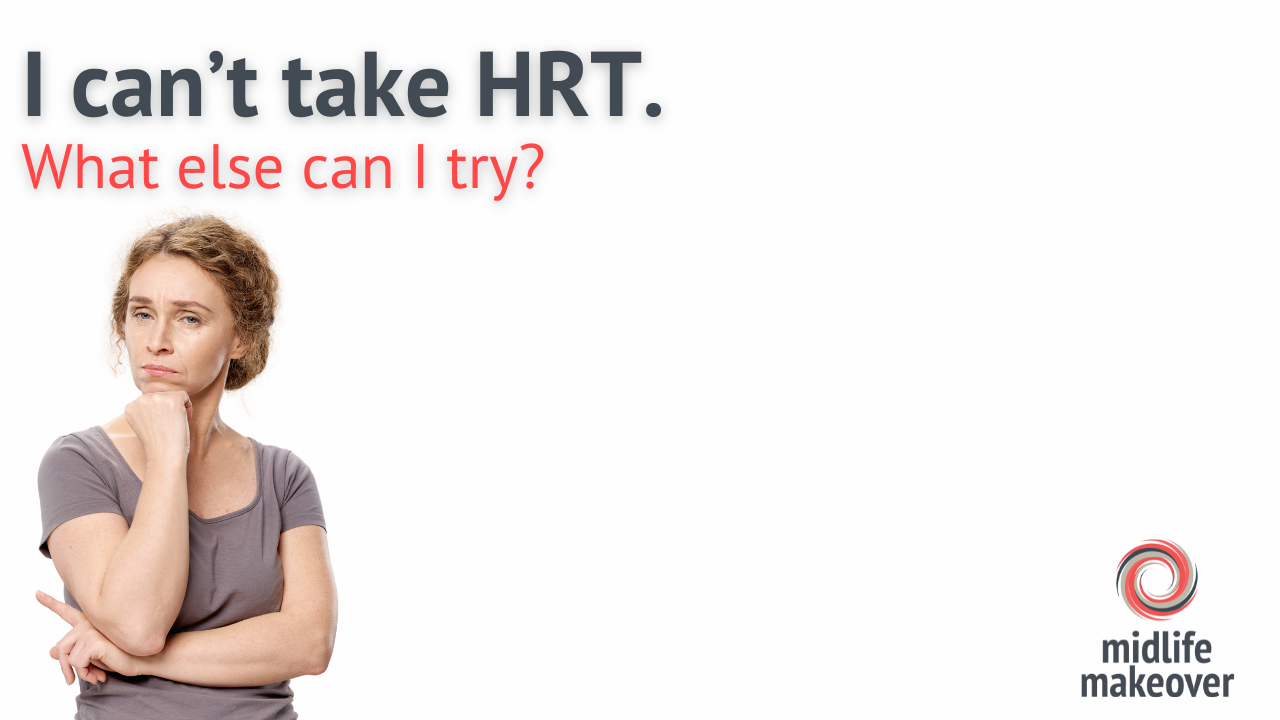
What can I do if I can’t take HRT — or don’t want to?
Perhaps HRT isn’t something you want to take. Perhaps you’ve tried it and it hasn’t suited you. Or perhaps you’ve been told you need to stop, when you were actually quite happy taking it.
Whatever your situation, you might be wondering, “Well, what am I supposed to do now?”
When so much of the menopause conversation revolves around HRT, it can feel as though you’ve been left without any options. I understand that feeling, particularly when stopping wasn’t your choice. But there are other treatments and practical ways to look after yourself, and you deserve help finding what works for you.
First, you don’t have to just put up with it
HRT can be very helpful, but it isn’t the only treatment available. Speak to your GP about the symptoms that are affecting you most and ask what else could help.
Menopause-specific cognitive behavioural therapy, or CBT, is one option that can help with the impact of hot flushes, sleep difficulties and some mood symptoms. Non-hormonal medicines may also be suitable, depending on your symptoms and medical history.
If you’re thinking about stopping HRT, discuss it with your prescriber first. There isn’t one stopping plan that suits everyone, particularly if you’ve been advised to stop for medical reasons. There’s also no universal deadline by which everyone must stop.
Get stronger, starting from where you are.
I would say this, wouldn’t I?
But strength matters for everyday life: carrying the shopping, getting out of a chair, lifting a grandchild and feeling confident on the stairs.
You can start at home with bodyweight movements, resistance bands or weights. The aim is to build gradually, so your muscles are doing a little more as you get stronger. It doesn’t have to mean joining a gym or finding an hour you haven’t got.
Walking, dancing, swimming and cycling all have a place too. Find movement you enjoy enough to keep doing, and include activities that challenge your strength and balance.
Exercise won’t necessarily switch off your hot flushes, but it can support your sleep, mood and longer-term health. That makes it worth doing, whether you take HRT or not.
Although it's frustrating - food MATTERS!
If you’re tired, hungry and already juggling too much, another restrictive diet probably isn’t going to improve your day.
Start with regular, satisfying meals. Include a source of protein, vegetables or fruit, and fibre-rich foods such as beans, oats or wholegrains. Calcium-rich foods matter for your bones too.
That might mean adding yoghurt to breakfast, beans to your soup or an extra portion of vegetables to dinner. Nothing terribly glamorous, but useful things rarely need an expensive subscription.
You don’t need a perfect diet. Start by asking yourself whether you’re eating enough nourishing food to get through the day without running on coffee and whatever you find in the biscuit tin.
My simple tips is to try to aim for 6 vegetables and 3 fruits every day - you might have to work up to it slowly!
Now be honest - how well do you sleep?
You can’t force yourself to sleep, and being told to “just relax” when you’ve been awake since 3am is enough to make anyone cross.
But you can experiment with things that make sleep easier: a reasonably consistent getting-up time, a cooler bedroom, less caffeine later in the day and a little space to wind down.
Notice how alcohol affects your nights too. You don’t have to change everything at once. Try one adjustment and see whether it helps.
If sleep continues to be a struggle, ask for support rather than assuming it’s something you have to live with.
Is there a pattern to your hot flushes?
Do they turn up after your morning coffee, during a stressful meeting, or seemingly whenever they fancy it?
Sometimes there’s a pattern; sometimes there isn’t. A hot room, alcohol, caffeine or stress might make things worse for some women, but your experience won’t necessarily be the same as your friend’s.
Before giving up coffee, wine and everything else you enjoy, it can be useful to jot down what’s happening.
Try my free seven-day Hot Flush Diary
My simple diary gives you somewhere to record when a flush happens, what was going on beforehand, how disruptive it felt and anything that helped.
The aim is to notice possible patterns, rather than decide that one cup of coffee is responsible for everything. It can also give you something useful to take to a conversation with your GP.
Download your free Hot Flush Diary
Look at all the 'stuff' you are dealing with.
Work, elderly parents, children, grandchildren, appointments, meals, remembering everyone’s birthdays… midlife can be quite a list.
You may not be able to remove those responsibilities, but could someone else take one thing off your plate? Could you protect ten minutes for a walk, a quiet cup of tea or a proper lunch?
Looking after yourself needs some room in your day. It shouldn’t always be what happens after everyone else has been sorted.
And if anxiety or low mood is affecting your everyday life, speak to your GP. You deserve more support than another suggestion to have a bath.
Be cautious about “natural” alternatives
It’s tempting to buy something that promises to balance your hormones or make your symptoms disappear. Particularly at 3am.
But “natural” doesn’t automatically mean safe or effective. Supplements and herbal remedies can interact with medicines, and some may be unsuitable if you have a history of hormone-sensitive cancer.
Before spending your money, check with your pharmacist or medical team. You can ask what evidence there is for the product, whether it’s safe for you and whether it could interfere with anything you’re already taking.
Something I’m planning for 2027
I’m hoping to launch a membership in 2027 for women navigating life without HRT, particularly those coming off it when they’d really rather not.
The working title is “How to Come Off HRT When You Don’t Really Want To”. A bit of a mouthful, I know, but it probably says what quite a few women are thinking.
My plan is to offer practical lifestyle support, reliable information and somewhere to talk about how it feels. Because when something has helped you feel well, the prospect of managing without it can be unsettling.
Decisions about whether and how to stop HRT, and any changes to medication, would stay with your prescriber. I’d help with the everyday business of looking after yourself alongside that.
Would this be helpful for you?
If you’re coming off HRT, have already stopped, or are facing the possibility when you’d really rather not, you can join my interest list.
I’ll keep you posted as my plans for 2027 take shape. There’s no commitment to join the membership — it simply means you’d like to hear more.
Keep me posted about the 2027 membership
For now, choose one small thing that would make looking after yourself a little easier this week. You don’t need another enormous to-do list.
Sam x
Enjoyed this? There’s lots more inside The Midlife Wellbeing Club.
Join The Midlife Wellbeing Club